
What Is a Paradox? Meaning, Types, and Examples Explained
Have you ever heard someone say, “Less is more” or “The only constant in life is change”? At first, these statements seem to contradict themselves. How can having less give you more? How can something remain constant if it keeps changing?
Yet, when you think about them more carefully, both statements communicate ideas that make sense. A simple design can be more effective than a complicated one, and change is one of the few things we can consistently expect in life.
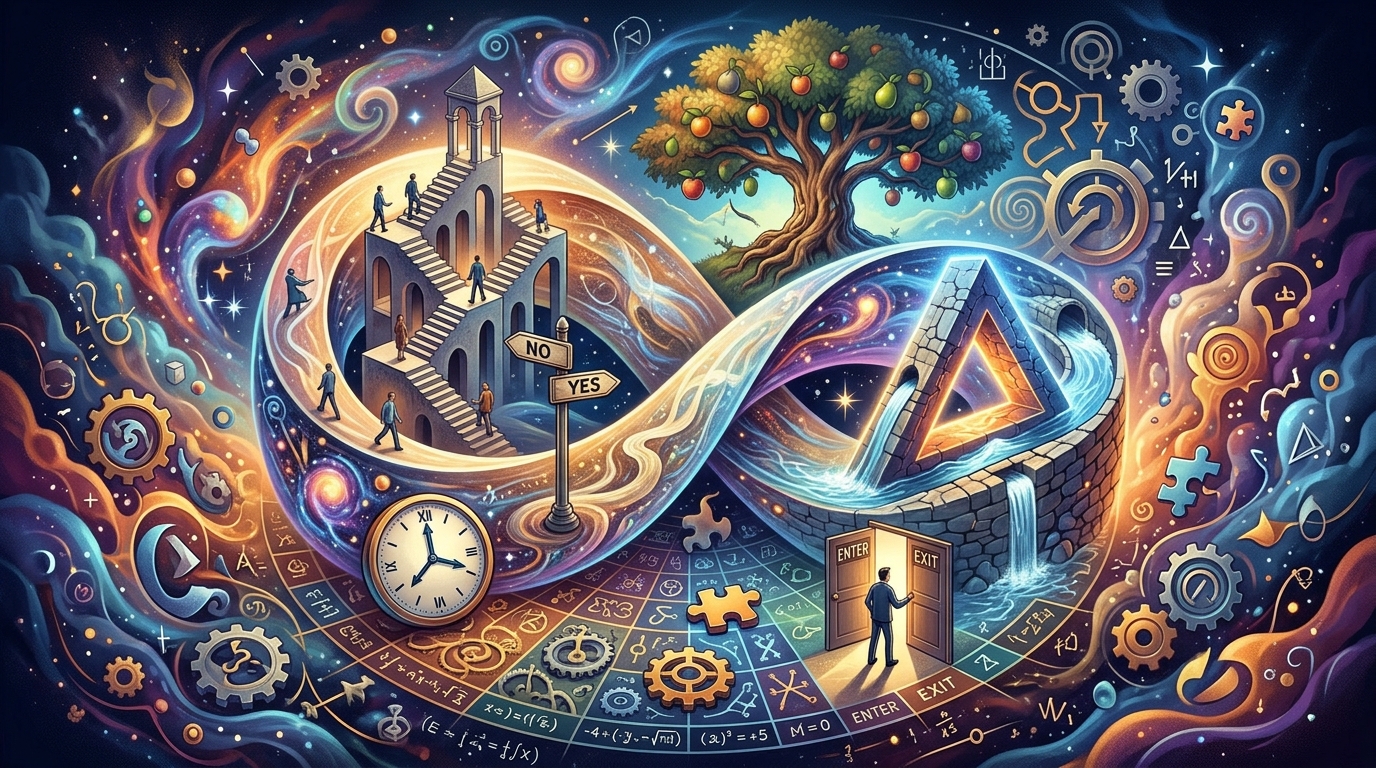
Table of Contents
This unusual combination of contradiction and meaning is what makes a paradox interesting.
A paradox is more than a clever expression or a confusing statement. It challenges ordinary assumptions, encourages deeper thinking, and sometimes exposes problems in the way we understand the world. Writers use paradoxes to communicate complex emotions, philosophers use them to examine difficult questions, and mathematicians use them to investigate the limits of reasoning.
Understanding paradoxes can also improve your writing. They help you express complicated ideas in memorable ways, create intellectual tension, and encourage readers to look beyond the literal meaning of a statement.
So, what exactly is a paradox, what are its different types, and how can you recognize one? Let’s explore its meaning, characteristics, and examples in detail.
What Is a Paradox?
A paradox is a statement, situation, or idea that appears contradictory, unreasonable, or impossible at first but may reveal an unexpected truth or expose a problem in our reasoning when examined more closely.
In simple terms, a paradox makes two seemingly incompatible ideas exist together.
Consider this familiar statement:
“The more you learn, the more you realize how little you know.”
At first, it sounds contradictory. Learning should increase knowledge, so why would it make someone feel less knowledgeable?
The explanation is that gaining knowledge also reveals how much information remains undiscovered. As people learn more about a subject, they often become more aware of its complexity and the limits of their understanding.
The statement is therefore not genuinely contradictory in its intended meaning. It expresses a deeper observation about learning and intellectual humility.
The word paradox comes from the Greek word paradoxos, meaning contrary to expectation or opinion. This origin reflects the central purpose of a paradox: challenging what people normally assume to be true.
A paradox can take several forms:
A contradictory statement: “Less is more.”
An apparently impossible situation: A person needs experience to get a job but cannot gain experience without getting a job.
A logical problem: “This statement is false.”
A philosophical question: If every part of an object is gradually replaced, is it still the same object?
Not every paradox has a simple solution. Some reveal a meaningful insight once their wording is understood, while others expose genuine difficulties in logic, mathematics, or philosophical reasoning.
This distinction is important because paradoxes are not always just clever expressions. They can also be serious intellectual problems that challenge established theories.
What Are the Main Characteristics of a Paradox?
Although paradoxes appear in different subjects and situations, they share several recognizable characteristics.
1. They Present an Apparent Contradiction
The most recognizable feature of a paradox is that it seems to oppose itself.
For example:
“The more you try to control everything, the less control you have.”
The statement creates an apparent contradiction. Control is generally associated with certainty, yet excessive attempts to control every situation can create stress, resistance, and unpredictable outcomes.
The apparent conflict encourages readers to question the literal meaning.
2. They Challenge Conventional Thinking
Paradoxes encourage people to reconsider assumptions that they might otherwise accept without questioning.
For example:
“Sometimes, the best way to move forward is to step back.”
This statement seems counterintuitive because moving forward generally means making progress. However, stepping back can mean reviewing a decision, correcting mistakes, or reconsidering a strategy before proceeding.
The paradox challenges the assumption that constant forward movement is always productive.
3. They Reveal Deeper Meanings
Many literary and everyday paradoxes communicate ideas that ordinary statements might struggle to express.
Consider:
“Silence speaks louder than words.”
Silence cannot literally speak. However, remaining silent can communicate disappointment, disagreement, grief, or disapproval more powerfully than a spoken response.
The contradiction gives the statement its emotional impact.
4. They Encourage Critical Thinking
A paradox invites readers to pause and examine the relationship between its ideas.
Instead of accepting a statement immediately, readers must investigate how its apparently conflicting parts can make sense together—or whether they can be reconciled at all.
This makes paradoxes useful in literature, philosophy, education, and scientific discussions.
5. They Can Have More Than One Interpretation
Some paradoxes depend on the way people interpret particular words or concepts.
For example:
“To preserve your freedom, you sometimes need to accept restrictions.”
This can sound contradictory because freedom and restrictions appear to be opposites. However, reasonable restrictions can protect people’s rights and prevent one person’s freedom from harming another.
The statement has a meaningful interpretation once its underlying assumptions are considered.
Not all paradoxes share every one of these characteristics. A literary paradox may reveal an unexpected truth, whereas a logical paradox may remain unresolved. Their common feature is the tension between what initially appears reasonable and what closer examination reveals.
Types of Paradoxes With Examples
Paradoxes are not limited to literature or everyday expressions. They appear in philosophy, mathematics, science, and logic.
Their purpose and structure can differ considerably depending on the subject. Some are designed to reveal a hidden truth, while others demonstrate that a particular set of assumptions leads to an impossible conclusion.
Here are eight important types of paradoxes and examples that help explain how each one works.
1. Literary Paradox
A literary paradox is a statement that appears self-contradictory but expresses a meaningful observation when interpreted beyond its literal wording.
Writers use literary paradoxes to create emphasis, communicate complex emotions, expose hypocrisy, and make readers reconsider familiar ideas.
Example: “I must be cruel only to be kind.” — William Shakespeare
This statement appears contradictory because cruelty and kindness are normally understood as opposing qualities.
Shakespeare uses this expression in Hamlet to communicate the idea that a painful or harsh action may sometimes be intended to produce a better outcome.
For example, a parent might impose a difficult restriction on a child to protect them from harmful behavior. Although the decision may seem unkind in the moment, its purpose may be to support the child’s long-term well-being.
More examples of literary paradoxes:
“Less is more.” — Simplicity can produce a stronger result than unnecessary complexity.
“The child is father of the man.” — William Wordsworth suggests that childhood experiences shape the adult a person becomes.
“I can resist everything except temptation.” — A humorous statement that exposes the weakness hidden behind a claim of self-control.
“All animals are equal, but some animals are more equal than others.” — George Orwell exposes the hypocrisy of a system that claims to promote equality while creating privilege.
Why writers use literary paradoxes: They make ordinary observations more memorable and encourage readers to explore meanings beyond the surface of a sentence.
2. Logical Paradox
A logical paradox occurs when an argument, statement, or set of assumptions leads to a contradictory or apparently impossible conclusion.
Unlike many literary paradoxes, logical paradoxes are not necessarily designed to reveal a hidden truth. Instead, they expose difficulties in reasoning, definitions, or the rules used to reach a conclusion.
Example: The Liar Paradox
Consider the statement:
“This sentence is false.”
Think about what happens if we try to determine whether the statement is true or false.
If the sentence is true, then what it says must be correct. Therefore, it is false.
If the sentence is false, then its claim that it is false is incorrect. Therefore, it is true.
Either answer creates another contradiction.
This problem is known as the Liar Paradox. It raises important questions about truth, self-reference, and how language can describe itself.
Another example: The Barber Paradox
Imagine a village with a barber who follows one rule: He shaves every man who does not shave himself, and nobody else.
Now ask an apparently simple question:
Does the barber shave himself?
If he shaves himself, he should not shave himself because he only shaves men who do not shave themselves.
If he does not shave himself, he must shave himself because he shaves every man who does not shave himself.
The contradiction suggests that the barber described in the problem cannot exist under the stated rules.
Why logical paradoxes matter: They help mathematicians, philosophers, and logicians examine the reliability of definitions, arguments, and systems of reasoning.
3. Philosophical Paradox
Philosophical paradoxes explore questions that do not always have straightforward answers. They challenge people’s assumptions about what makes something true, real, identical, or meaningful.
Example: The Ship of Theseus
Imagine a wooden ship that has been sailing for many years. Over time, its wooden planks become damaged and are gradually replaced with new ones.
Eventually, every original plank has been replaced.
Now consider this question:
Is the ship still the same ship?
There are two possible ways to approach the problem.
One argument says it is the same ship because its identity, history, and continuous existence have remained intact.
Another argument says it is a different ship because none of its original physical components remain.
The question becomes even more complicated if someone collects all the original planks and uses them to reconstruct another ship.
Which ship is the original?
The Ship of Theseus paradox raises questions about personal identity, continuity, and the relationship between an object’s physical components and its identity.
It can also be applied to everyday situations. For instance, if a person gradually changes their beliefs, personality, appearance, and habits over several decades, what makes them the same person?
Why philosophical paradoxes matter: They help us investigate abstract concepts that are difficult to define through ordinary observation alone.
4. Mathematical Paradox
Mathematical paradoxes occur when mathematical arguments produce results that seem impossible or conflict with ordinary intuition.
Some arise from incorrect assumptions or misleading interpretations, while others reveal limitations in mathematical concepts and reasoning.
Example: The Potato Paradox
Imagine you have 100 kilograms of potatoes containing 99% water.
This means:
Water weight = 99 kilograms.
Dry matter weight = 1 kilogram.
Now suppose the potatoes are dried until their water content becomes 98%.
The important point is that the dry matter still weighs 1 kilogram.
If dry matter represents 2% of the potatoes’ final weight, the total weight must be:
Final weight = 1 ÷ 0.02 = 50 kg
Therefore, the potatoes now weigh 50 kilograms rather than 100 kilograms.
They have lost half their original weight, even though their water content has decreased by only one percentage point.
This result surprises people because they often confuse a change in percentage with a change in absolute weight.
Another example: Zeno’s Dichotomy Paradox
The ancient Greek philosopher Zeno of Elea presented arguments that appear to make motion impossible.
Imagine walking from one side of a room to another.
Before reaching your destination, you must first travel half the distance. Before reaching that point, you must travel half of that distance. This process can continue indefinitely.
It seems that you must complete infinitely many smaller journeys before reaching the destination.
So how can you ever arrive?
Modern mathematics explains how an infinite sequence of progressively smaller distances can have a finite total through the concept of a convergent infinite series.
For example:
1/2 + 1/4 + 1/8 + 1/16 + … = 1
The infinitely many fractions add up to a finite distance.
Why mathematical paradoxes matter: They encourage people to examine mathematical assumptions, understand infinity, and distinguish intuitive expectations from rigorous mathematical reasoning.
5. Set Theory Paradox
Set theory is a branch of mathematics concerned with collections of objects, known as sets.
A set theory paradox arises when the rules used to define collections produce an apparent contradiction.
Example: Russell’s Paradox
Imagine a collection containing every set that does not contain itself.
Now consider the question:
Does this particular set contain itself?
There are two possibilities:
If it contains itself, it should not belong to the collection because the collection only includes sets that do not contain themselves.
If it does not contain itself, it meets the condition for belonging to the collection and therefore should contain itself.
Both possibilities lead to contradictions.
The paradox was introduced by British philosopher and mathematician Bertrand Russell and exposed a fundamental problem in unrestricted approaches to set formation.
It played an important role in the development of more carefully constructed foundations for mathematics.
Why set theory paradoxes matter: They demonstrate why mathematical systems need precise definitions and consistent rules when describing collections and their relationships.
6. Time Paradox
Time paradoxes are common in science fiction and philosophical discussions about the possibility of traveling through time.
They explore what might happen if someone could travel into the past and change events that contributed to their own existence.
Example: The Grandfather Paradox
Imagine a person travels back in time and accidentally prevents their grandfather from meeting their grandmother.
As a result, the person’s parent is never born, and the time traveler is never born either.
But if the time traveler was never born, how could they have traveled into the past and prevented their grandparents from meeting?
This creates a contradiction between the original timeline and the consequences of changing it.
The Grandfather Paradox raises questions about causality and whether the past can be changed without creating logical inconsistencies.
Another example: The Bootstrap Paradox
Imagine a writer travels into the future and finds a famous book. They take the book back to the past and publish it under their own name.
Years later, that same book becomes famous and is eventually discovered by the time traveler.
But who originally wrote it?
The information appears to exist in a closed time loop without an identifiable point of origin.
Why time paradoxes matter: They help explore the relationship between cause and effect, the consistency of timelines, and the theoretical difficulties associated with time travel.
7. Omnipotence Paradox
The omnipotence paradox examines whether an all-powerful being can perform an action that would appear to limit its own power.
Example: The Unliftable Stone
Consider this question:
Can an all-powerful being create a stone so heavy that it cannot lift it?
The question produces two apparently contradictory possibilities.
If the being can create the stone but cannot lift it, then there is something it cannot do.
If the being cannot create such a stone, then there is also something it cannot do.
Either answer seems to challenge the idea of unlimited power.
However, philosophers have approached this problem in different ways. One common response is that the paradox involves a logically contradictory task rather than a genuinely possible action.
For instance, asking whether someone can create a square circle does not describe a meaningful physical challenge. It combines incompatible definitions.
The debate therefore raises a broader question: Should unlimited power include the ability to perform logically impossible actions?
Why this paradox matters: It demonstrates how philosophical reasoning can reveal difficulties hidden inside seemingly straightforward definitions.
8. Socratic Paradox
Socratic paradoxes are philosophical claims associated with the teachings and arguments of the ancient Greek philosopher Socrates.
One familiar expression associated with Socratic philosophy is:
“I know that I know nothing.”
The statement appears contradictory. If someone knows nothing, how can they know that they know nothing?
The deeper idea concerns intellectual humility.
A person who recognizes the limits of their knowledge may be wiser than someone who assumes they understand everything. Recognizing ignorance creates an opportunity to ask questions, investigate evidence, and learn.
The expression is commonly used to summarize a theme associated with Socrates rather than being treated as a verified verbatim quotation.
Why Socratic paradoxes matter: They encourage self-examination, curiosity, and a willingness to recognize the limitations of personal knowledge.
10 Famous Paradox Examples in Literature and Everyday Life
Paradoxes are particularly effective when they communicate complex ideas through short, memorable statements.
Some have become famous because of their use in literature, while others appear in ordinary conversations and everyday experiences.
| Paradox example | Explanation |
|---|---|
| “Less is more.” | Simplicity can produce greater value or effectiveness than excess. |
| “The only constant is change.” | Change itself is a permanent feature of life. |
| “The more you know, the more you realize you don’t know.” | Learning reveals how much remains unknown. |
| “I must be cruel only to be kind.” — Shakespeare | A harsh action may be intended to achieve a positive outcome. |
| “All animals are equal, but some animals are more equal than others.” — George Orwell | A system can claim equality while practicing discrimination and privilege. |
| “I can resist everything except temptation.” | A humorous statement that exposes the weakness hidden behind a claim of self-control. |
| “War is peace. Freedom is slavery. Ignorance is strength.” — George Orwell | Contradictory slogans expose the manipulation of language in authoritarian systems. |
| “It was the best of times, it was the worst of times.” — Charles Dickens | The same historical period can create radically different experiences for different people. |
| “To be natural is such a very difficult pose to keep up.” | Trying deliberately to appear natural can make authenticity feel artificial. |
| “The child is father of the man.” — William Wordsworth | Childhood experiences help shape adult identity. |
These examples illustrate an important point: a paradox does not always need to be a complicated philosophical puzzle. Sometimes, a single sentence is enough to make readers question an assumption.
Everyday Situations That Reflect Paradoxical Thinking
Paradoxes are not restricted to books or academic discussions. Many ordinary situations involve seemingly contradictory relationships.
1. The Experience Paradox
“You need experience to get a job, but you need a job to gain experience.”
This describes a common difficulty faced by people entering the workforce. Employers may expect previous experience, while newcomers need employment opportunities to develop that experience.
2. The Privacy Paradox
People may express concern about the collection of their personal information while willingly sharing personal details on digital platforms.
The apparent contradiction reflects the tension between privacy preferences and convenience, social participation, or access to services.
3. The Choice Paradox
“Having more choices can make decisions harder.”
People generally assume that additional options make decision-making easier. However, too many possibilities can increase uncertainty, comparison, and fear of making the wrong decision.
4. The Investment Paradox
“You have to spend money to make money.”
Although spending and saving appear to conflict, certain expenditures—such as purchasing equipment, developing professional skills, or investing in a business—can create opportunities for future income.
5. The Progress Paradox
“The faster you try to finish everything, the longer it may take.”
Rushing can lead to mistakes, incomplete work, and repeated corrections. Taking time to plan and check a task can sometimes produce faster overall results.
These examples show that paradoxical thinking can help people recognize relationships that are not immediately obvious.
What Is the Difference Between a Paradox and an Oxymoron?
Paradox and oxymoron are closely related literary devices. Both involve contradictions, which is why they are sometimes confused.
However, they differ in structure, purpose, and the way they communicate meaning.
An oxymoron combines two contradictory or opposing words to create a particular expression.
A paradox, on the other hand, usually presents a complete idea, statement, or situation that appears contradictory but may communicate a deeper meaning.
Examples of Oxymorons
Deafening silence
Living dead
Bittersweet
Open secret
Examples of Paradoxes
Less is more.
The only constant is change.
I must be cruel only to be kind.
The more you know, the more you realize how much you don’t know.
Key Differences Between Paradox and Oxymoron
| Feature | Paradox | Oxymoron |
|---|---|---|
| Definition | An apparently contradictory idea or statement | Two opposing words combined |
| Structure | Usually a sentence, proposition, or situation | Usually a short phrase |
| Purpose | Reveals an unexpected truth or challenges reasoning | Creates emphasis, contrast, or a particular effect |
| Example | Less is more. | Deafening silence. |
| Interpretation | Often requires deeper examination | Usually understood through the contrast between the words |
An easy way to remember the difference: An oxymoron places opposing words together, while a paradox presents an apparently contradictory idea.
For example, “deafening silence” is an oxymoron because it combines two contrasting words. “Silence speaks louder than words” is a paradox because it expresses a complete idea that challenges the literal meaning of silence.
What Is the Difference Between a Paradox and Irony?
Paradox and irony can both surprise readers by challenging their expectations. However, they achieve this through different techniques.
Irony involves a difference between what is expected and what actually happens, or between what someone says and what they really mean.
Paradox involves an apparent contradiction within a statement, idea, or situation.
Consider these examples:
Paradox: “The only constant in life is change.”
The statement appears contradictory because change is described as something constant. Its meaning is that change is an unavoidable and continuing part of life.
Irony: A fire station catches fire.
A fire station is a place designed to respond to fires, so having the building itself catch fire creates an unexpected and ironic situation.
| Feature | Paradox | Irony |
|---|---|---|
| Main idea | Apparent contradiction | Contrast between expectation and reality or intended and literal meaning |
| Main purpose | Encourage deeper thinking | Create surprise, humor, criticism, or emphasis |
| Common forms | Literary and logical paradoxes | Verbal, situational, and dramatic irony |
| Example | Less is more. | A traffic police officer receives a speeding ticket. |
A paradox can sometimes create an ironic effect, but the two devices are not interchangeable.
What Is the Difference Between a Paradox and Antithesis?
Antithesis is another literary device that is often confused with paradox because both can involve opposing ideas.
Antithesis places contrasting ideas together, usually in a balanced grammatical structure, to emphasize their differences.
Unlike a paradox, antithesis does not necessarily involve a logical contradiction.
Consider the statement:
“To err is human; to forgive, divine.” — Alexander Pope
The sentence places human error against divine forgiveness. The ideas contrast with each other, but they do not create an impossible situation.
Now consider:
“Less is more.”
This statement appears to contradict itself because less and more represent opposing quantities. However, it communicates an unexpected observation about simplicity and effectiveness.
| Feature | Antithesis | Paradox |
|---|---|---|
| Main technique | Contrasting ideas | Apparent contradiction |
| Structure | Often balanced phrases or clauses | Can be a phrase, sentence, argument, or situation |
| Purpose | Emphasize differences | Challenge assumptions or reveal deeper meaning |
| Example | “To err is human; to forgive, divine.” | “Less is more.” |
An important distinction is that antithesis can appear within a paradox. However, simply presenting two opposing ideas does not automatically create a paradox.
What Is the Difference Between a Paradox and a Contradiction?
A contradiction occurs when two claims cannot both be true under the same conditions and in the same sense.
For example:
The door is open.
The door is not open.
If both statements refer to the same door at the same time and use the same meaning of “open,” they cannot both be true.
A paradox is more complicated.
It may initially appear contradictory but reveal a meaningful interpretation when examined carefully. Alternatively, it may expose a genuine problem in a logical system.
For example:
“Sometimes, giving up control gives you greater control.”
This statement appears contradictory, but it can make sense in situations where allowing others to take responsibility improves the overall outcome.
The key distinction is that a simple contradiction states incompatible claims, whereas a paradox creates a puzzle that requires further examination.
Why Do Writers Use Paradoxes?
Paradoxes are valuable writing techniques because they allow authors to communicate complicated ideas without lengthy explanations.
A well-written paradox can make a reader stop, reconsider an assumption, and discover a meaning that might otherwise go unnoticed.
Here are some important reasons writers use paradoxes.
1. To Make Writing More Thought-Provoking
A straightforward statement communicates information directly. A paradox encourages readers to think about the relationship between different ideas.
For example:
“Failure is the beginning of success.”
Rather than simply saying that mistakes help people learn, the paradox creates an interesting contrast between failure and achievement.
Readers are encouraged to consider how unsuccessful experiences can contribute to future progress.
2. To Express Complex Emotions
Human emotions are not always straightforward. People can experience happiness and sadness, love and frustration, or hope and fear simultaneously.
Paradoxes help writers express these complicated feelings.
For example:
“I feel alone even when surrounded by people.”
The statement expresses the emotional experience of loneliness despite physical company. It captures a feeling that might be difficult to communicate through ordinary language.
3. To Expose Hypocrisy
Writers frequently use paradoxes to criticize social systems, political institutions, and human behavior.
George Orwell’s famous statement from Animal Farm illustrates this technique:
“All animals are equal, but some animals are more equal than others.”
The statement exposes the contradiction between a system’s claim of equality and its actual treatment of individuals.
The paradox makes the criticism memorable because the language of equality is used to justify inequality.
4. To Create Humor and Wit
Paradoxes can also make writing entertaining.
Oscar Wilde frequently used paradoxical statements to challenge social conventions and expose human weaknesses through humor.
For example:
“I can resist everything except temptation.”
The statement is funny because the speaker’s claim of complete self-control immediately collapses when temptation is mentioned.
This type of paradox works particularly well in dialogue, satire, comedy, and social commentary.
5. To Strengthen Literary Themes
A paradox can communicate the central theme of a literary work.
In George Orwell’s Nineteen Eighty-Four, the slogans “War is peace,” “Freedom is slavery,” and “Ignorance is strength” illustrate the manipulation of language and thought by an authoritarian government.
These contradictory expressions reinforce the novel’s exploration of propaganda, political control, and the distortion of truth.
The paradoxes are not merely decorative language. They contribute directly to the meaning of the story.
How to Identify a Paradox in a Sentence
Recognizing a paradox becomes easier when you know what to look for.
Not every sentence containing opposite words is a paradox. The important factor is whether the statement presents an apparent contradiction that creates a meaningful question or reveals an unexpected idea.
Use the following steps to identify one.
Step 1: Look for an Apparent Contradiction
Read the statement carefully and identify the ideas that seem to conflict.
Example: “The more you give, the more you receive.”
Giving and receiving may appear to be opposing actions.
Step 2: Examine the Literal Meaning
Ask yourself whether the statement makes sense when interpreted word for word.
In the example, giving something away would normally seem to reduce what you possess.
Step 3: Consider the Intended Meaning
Look beyond the literal interpretation.
The statement may refer to generosity, relationships, kindness, or emotional satisfaction. Giving can strengthen relationships and create goodwill, which may eventually benefit the giver.
Step 4: Determine Whether the Contradiction Reveals an Insight
A meaningful paradox offers something beyond confusion.
If examining the statement reveals an observation about human behavior, society, or the world, it may be a literary paradox.
If the contradiction remains unresolved because of the underlying logic, it may be a logical paradox.
Step 5: Distinguish It From Other Literary Devices
Check whether the statement is simply an oxymoron, antithesis, or example of irony.
For instance, “bittersweet” is an oxymoron, not a complete paradox.
Following these steps can help you recognize paradoxes in novels, poems, essays, speeches, and everyday conversations.
How to Write an Effective Paradox
Creating a paradox requires more than combining opposite words. The statement should contain a meaningful idea that encourages readers to reconsider something they normally believe.
Here is a practical approach to writing one.
1. Choose a Familiar Concept
Begin with a subject that readers can easily understand.
Possible topics include:
Love and relationships
Success and failure
Knowledge and ignorance
Freedom and responsibility
Happiness and sadness
Time and change
Power and control
Familiar concepts make it easier for readers to recognize the contradiction.
2. Identify an Unexpected Relationship
Think about how two seemingly opposing ideas might be connected.
For example, consider the relationship between simplicity and effectiveness.
People often assume that adding more features, information, or decoration improves something.
However, excessive complexity can make a product, design, or explanation less effective.
This relationship creates the foundation for the paradox:
“Less is more.”
3. Create the Apparent Contradiction
Express the relationship in a short, direct statement.
For example:
“The strongest people know when to ask for help.”
Strength is often associated with independence, while asking for help may be mistakenly viewed as weakness.
The statement challenges that assumption by suggesting that recognizing limitations and seeking support can demonstrate strength.
4. Make Sure the Statement Has a Meaningful Interpretation
A paradox should not be confusing simply for the sake of sounding clever.
Consider:
“Blue is faster than yesterday.”
This sentence combines unrelated ideas but does not communicate a meaningful contradiction.
Compare it with:
“The more you try to control everything, the less control you have.”
This statement presents an apparent contradiction while expressing a recognizable observation about excessive control and uncertainty.
5. Keep It Clear and Memorable
The strongest literary paradoxes are often relatively short.
Avoid explaining every detail inside the paradox itself. Let the statement create curiosity, and use the surrounding paragraph to explore its meaning when necessary.
For academic writing, make sure the paradox supports your argument rather than replacing evidence or logical explanation.
Frequently Asked Questions About Paradoxes
1. What Is a Paradox in Simple Words?
A paradox is a statement or situation that seems contradictory or impossible at first but may reveal a deeper meaning when examined carefully. For example, “Less is more” suggests that simplicity can sometimes produce better results than excess.
2. What Is the Best Example of a Paradox?
“Less is more” is one of the most recognizable examples. It appears contradictory because having less should mean having a smaller quantity. However, it communicates the idea that simplicity can be more effective, attractive, or valuable than unnecessary complexity.
3. What Are the Three Main Types of Paradoxes?
There is no single universally accepted classification of paradoxes. However, three widely discussed categories are:
Literary paradox: An apparently contradictory statement that reveals a deeper meaning.
Logical paradox: A reasoning problem that produces an apparent contradiction.
Philosophical paradox: A thought experiment or argument that challenges fundamental assumptions about reality, knowledge, or identity.
Other important categories include mathematical, set theory, time, and omnipotence paradoxes.
4. Is a Paradox Always a Contradiction?
No. A paradox often appears contradictory, but not every paradox represents a straightforward contradiction.
Literary paradoxes frequently reveal a meaningful interpretation when examined beyond their literal wording. Logical paradoxes, on the other hand, can expose genuine inconsistencies or unresolved problems in reasoning.
5. Can a Paradox Be True?
Yes. Many literary paradoxes communicate observations that are meaningful and reasonable despite their apparently contradictory wording.
For example, “The only constant is change” expresses the idea that change is an unavoidable part of life.
However, some logical paradoxes are not simply true statements. They are problems that reveal difficulties in definitions, assumptions, or reasoning.
6. What Is an Example of a Paradox in Everyday Life?
A familiar example is:
“You need experience to get a job, but you need a job to gain experience.”
This describes a challenge faced by many people entering the workforce. Employers may expect previous experience, while new applicants need employment opportunities to develop that experience.
Another example is “The more you learn, the more you realize how much you don’t know.”
7. What Is the Difference Between a Paradox and an Oxymoron?
An oxymoron combines two opposing words to create an expression, such as “deafening silence” or “bittersweet.”
A paradox presents a seemingly contradictory statement or situation, such as “Silence speaks louder than words.”
The main difference is that an oxymoron usually operates at the phrase level, while a paradox communicates a broader idea.
8. What Is the Difference Between a Paradox and Irony?
A paradox involves an apparent contradiction within an idea or statement.
Irony involves a difference between what is expected and what actually happens, or between what is said and what is intended.
For example, “Less is more” is a paradox, while a fire station catching fire is an example of situational irony.
9. Who Introduced the Concept of Paradox?
There is no single person credited with introducing paradoxes. They have been explored since ancient times in philosophy, mathematics, and language.
Ancient Greek philosophers such as Zeno of Elea developed famous paradoxical arguments about motion and infinity. Socrates also became associated with paradoxical philosophical claims. Later thinkers, including Bertrand Russell, contributed significantly to the study of logical and mathematical paradoxes.
10. What Is the Purpose of a Paradox in Literature?
Writers use paradoxes to attract attention, express complex emotions, communicate deeper meanings, challenge conventional beliefs, and expose hypocrisy.
They can also create humor, strengthen themes, and make particular statements more memorable.
11. Can a Paradox Be Used in Academic Writing?
Yes. Paradoxes can be useful in academic writing when they help introduce a complex issue, highlight conflicting findings, or encourage critical discussion.
For example, a researcher might discuss the privacy paradox to examine why individuals express concerns about personal data collection while continuing to share information online.
However, academic writers should explain the underlying issue clearly and support their arguments with evidence rather than relying on paradoxical statements alone.
12. Is “The Only Constant Is Change” a Paradox?
Yes. It is a literary or philosophical paradox because it appears to contradict itself. The word “constant” suggests something permanent, while “change” describes something that does not remain the same.
Its deeper meaning is that change itself is an unavoidable and continuing feature of life.
Conclusion
A paradox is an interesting way of expressing an idea that appears contradictory but encourages deeper thinking. Whether it appears in literature, everyday conversations, philosophy, mathematics, or logic, its central purpose is to challenge ordinary assumptions and make people examine ideas more carefully.
From Shakespeare’s “I must be cruel only to be kind” to Orwell’s “All animals are equal, but some animals are more equal than others,” paradoxes demonstrate how seemingly conflicting ideas can communicate powerful messages.
Understanding the difference between literary, logical, and philosophical paradoxes also makes it easier to recognize how they work in different contexts. It helps distinguish paradoxes from related literary devices such as oxymorons, irony, and antithesis.
Ultimately, a paradox reminds us that not everything meaningful is immediately obvious. Sometimes, questioning what appears contradictory is precisely what helps us understand an idea more clearly.